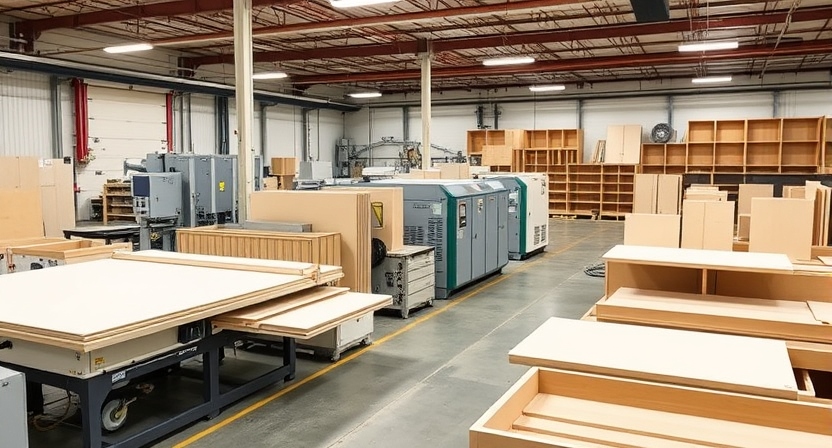
The essential equipment for cabinet manufacturing typically includes panel cutting or CNC nesting machinery, edge banding equipment, drilling and boring machines, and tools or systems for component handling and assembly. The exact setup depends on whether a factory produces custom cabinets, standardized products, or higher-volume panel furniture.
Cabinet production is a sequence of connected processes. MDF, plywood, particleboard, and other panels must be converted into accurately sized components, finished along exposed edges, drilled for hardware and connections, organized, and finally assembled. Choosing machinery around this workflow helps avoid gaps between production stages.
What Does a Cabinet Manufacturing Process Include?
Most panel-based cabinets contain sides, shelves, tops, bottoms, doors, drawer parts, backs, and other components.
Although designs vary, a common manufacturing sequence is:
Panel preparation → cutting or nesting → edge banding → drilling and boring → component identification → assembly
Some cabinet styles require additional routing, sanding, pressing, or finishing.
Before choosing machines, a manufacturer should therefore identify the materials it processes, component dimensions, expected production volume, degree of customization, and hardware requirements.
Panel Cutting Equipment Creates Cabinet Parts
Full-size panels must first be converted into individual cabinet components.
Panel saws are commonly used for this task. They cut MDF, plywood, particleboard, laminated boards, and similar sheet materials according to specified dimensions.
Different saw configurations serve different production environments.
A sliding table saw can provide flexibility for varied cutting work. Beam saw systems are more closely associated with structured panel processing where batches of parts need to be cut efficiently.
Whichever method is used, dimensional accuracy is important. An incorrectly cut cabinet side or shelf can cause problems during edge banding, drilling, and assembly.
Cutting equipment should therefore be selected according to sheet dimensions, panel thickness, cutting patterns, required accuracy, and expected workload.
CNC Nesting Offers an Alternative Panel Workflow
A nesting CNC machine can combine panel cutting with programmable machining.
In a nesting process, software arranges cabinet components within a sheet. The CNC system then follows programmed paths to produce the parts.
Depending on the machine setup and tooling, nesting can incorporate:
- Cutting
- Routing
- Grooving
- Pocketing
- Selected drilling
- Shaped component machining
This approach can be particularly useful for custom cabinet production because different component dimensions can be generated from digital design data.
However, CNC nesting does not eliminate the need for downstream planning. Once components leave the CNC station, many still require edge treatment, additional drilling, sorting, and assembly.
Edge Banding Equipment Finishes Panel Edges
Edge banding is a major stage in panel-based cabinet manufacturing.
Materials such as particleboard and MDF often have exposed edges after cutting. Applying an appropriate edge material creates the finished appearance required for visible cabinet components.
An edge banding machine applies and processes this material along the panel edge.
The appropriate machine depends on factors such as panel thickness, edge material, component size, production quantity, and required finish.
For example, a manufacturer producing large quantities of standardized cabinet parts may prioritize consistent feeding and efficient processing. A custom shop may place greater emphasis on flexibility across different component sizes.
Edge banding capacity should also match upstream production. If cutting or nesting produces parts much faster than edge processing can handle them, components can accumulate between stages.
Drilling and Boring Machines Prepare Components for Hardware
Cabinets depend on accurately positioned holes for assembly and hardware installation.
Typical drilling requirements can include:
- Shelf-support holes
- Hinge locations
- Dowels
- Connectors
- Drawer hardware
- Assembly fittings
Multi-boring machines can be practical when manufacturers repeatedly use standardized hole patterns.
CNC drilling equipment provides programmable positioning where cabinet dimensions or hardware patterns vary between products. More advanced configurations may process multiple faces of a panel, reducing the amount of manual repositioning required.
Drilling accuracy is important because the external dimensions of a component can be correct while incorrectly positioned holes still prevent proper assembly.
Choosing Cabinet Manufacturing Equipment as a System
Individual machines should be evaluated according to how they contribute to the complete cabinet-production process.
A manufacturer planning cabinet manufacturing equipment should consider the relationship between panel cutting, CNC processing, edge banding, drilling, component handling, and assembly rather than evaluating each machine only by its maximum operating speed.
For example, increasing panel-cutting capacity provides limited benefit if drilling becomes a persistent bottleneck. Similarly, advanced CNC equipment may be underused if material loading, labeling, or downstream processing cannot support its output.
A balanced workflow is therefore more important than maximizing the specification of one machine.
Is a CNC Router Necessary for Cabinet Manufacturing?
A CNC router is not mandatory for every cabinet factory, but it can be useful when components require programmable routing or varied machining.
Cabinet manufacturers may use CNC routers for grooves, recesses, profiles, shaped components, door details, and other operations that would be less convenient with basic cutting equipment.
The decision depends largely on product complexity.
A factory producing straightforward rectangular cabinet boxes may have different CNC requirements from a business manufacturing customized cabinetry with decorative panels, specialized fittings, or frequently changing dimensions.
The question should therefore be whether CNC routing solves a recurring production requirement rather than whether every modern cabinet shop must own one.
What Equipment Is Needed for Cabinet Doors?
Cabinet doors can require a separate manufacturing process from cabinet boxes.
Flat panel doors may need relatively simple cutting and edge processing. Routed MDF doors can require CNC machining for decorative profiles or recessed designs.
Solid-wood doors can involve additional machinery for timber preparation, planing, moulding, joint creation, sanding, and assembly.
Surface treatment may introduce further requirements depending on whether doors are laminated, painted, coated, or finished in another way.
Manufacturers producing doors in-house should account for these operations when planning the factory instead of assuming that equipment used for cabinet boxes will handle every door design.
Component Identification and Material Handling Matter
Machining is only part of cabinet production.
Components also need to move between cutting, edge banding, drilling, and assembly without being mixed up or damaged.
This becomes especially important in custom production. Two panels may look almost identical while having different dimensions, drilling patterns, or final positions within an order.
Labels or another reliable identification method can help workers keep components associated with the correct cabinet and machining sequence.
Factory layout also affects efficiency. Excessive movement between machines can consume time even when individual machining operations are fast.
When Should Cabinet Production Be Automated?
Automation is most useful when it addresses a clear production problem.
Potential applications include panel loading, CNC nesting, labeling, drilling, sorting, and material transfer. Yet a smaller manufacturer may not need automation at every stage.
Factories should first identify repetitive manual tasks, production queues, frequent setup requirements, and areas where errors or component tracking create difficulties.
Automation can then be introduced where it supports a measurable workflow need.
This approach prevents manufacturers from adding complexity without solving an actual production constraint.
How to Plan the Right Cabinet Manufacturing Setup
The best equipment plan starts with the cabinets the factory intends to produce.
Manufacturers should list their panel materials, component sizes, cutting requirements, edge treatments, drilling patterns, door styles, batch sizes, and assembly methods. Each requirement can then be connected to the machinery needed to perform it.
For many panel-based operations, the core setup will involve panel cutting or CNC nesting, edge banding, and drilling or boring. CNC routing, automated handling, specialized door-processing machinery, and additional finishing equipment can be added when the product range requires them.
By planning equipment around the complete path from raw panel to assembly-ready component, a cabinet manufacturer can build a production setup in which each machine has a clear purpose and supports the stages around it.