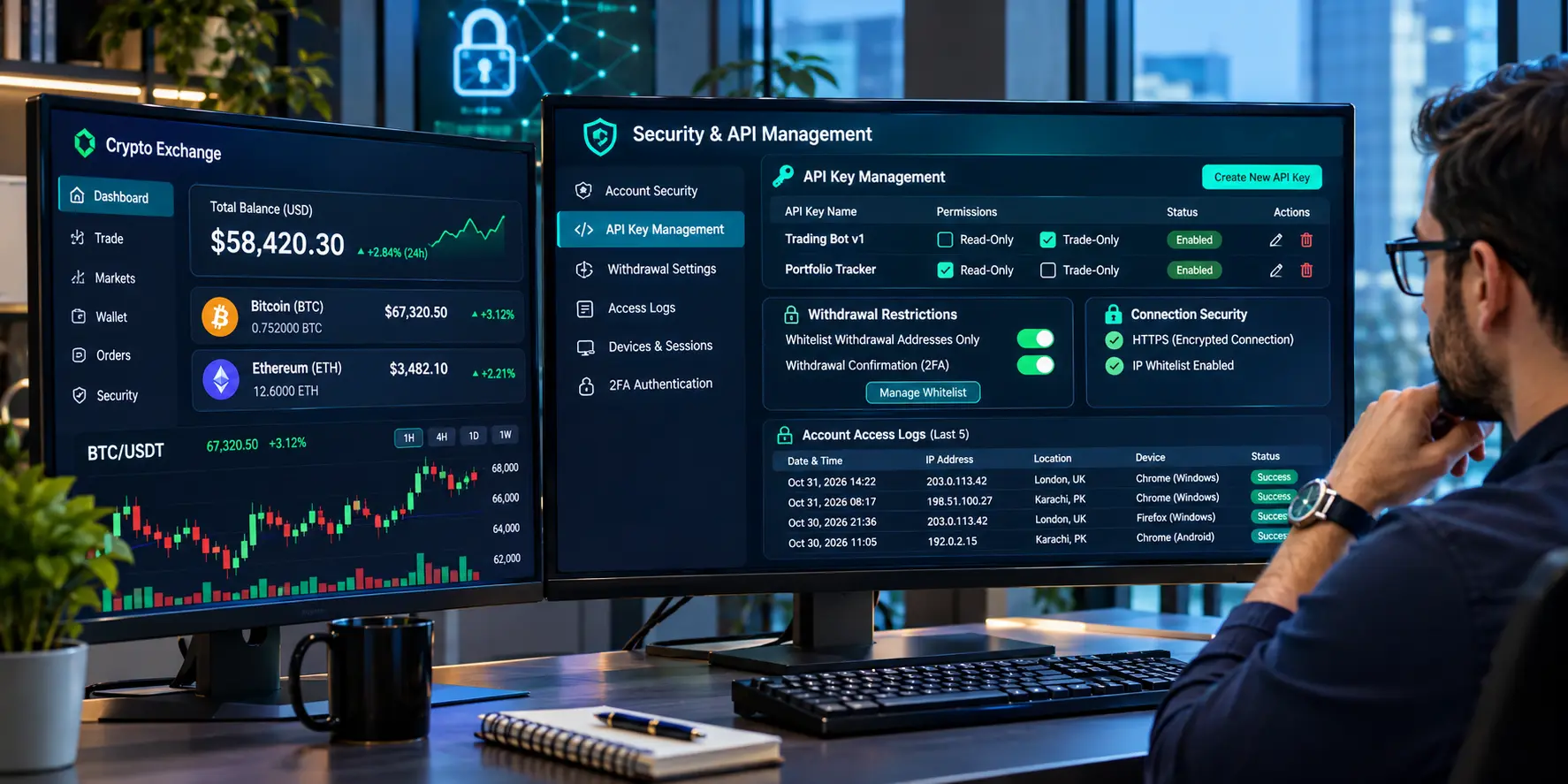
AI trading security depends on how automated trading software connects to financial accounts, handles sensitive credentials, and controls access to invested assets. When an AI trading platform integrates with a cryptocurrency exchange, its security architecture can determine whether the software can only analyze market data, execute trades, or perform additional account actions.
Understanding API keys, exchange custody, encryption, and trading permissions helps investors evaluate the risks of connecting external software to their accounts.
Although artificial intelligence can support market analysis and automated execution, it does not automatically make a trading platform secure.
What Is AI Trading Security?
AI trading security refers to the technical and operational safeguards used to protect financial accounts, trading credentials, personal information, and automated transactions.
These safeguards may include authentication systems, encrypted communications, restricted API permissions, credential management, and activity monitoring.
For example, a cryptocurrency trading application might require access to market information and permission to submit orders.
However, those functions do not necessarily require the ability to withdraw cryptocurrency from an exchange account.
A secure integration should follow the principle of least privilege, meaning software receives only the permissions necessary for its intended functions.
How API Keys Work in Automated Trading
An application programming interface, or API, allows two software systems to exchange information and perform authorized actions.
Cryptocurrency exchanges commonly provide APIs that external applications can use for account monitoring and trading.
An API key identifies an application or account connection, while an associated secret or other authentication mechanism helps verify authorized requests.
Depending on the exchange, API credentials may support different permission levels.
Common API Permissions and Trading Security
| Permission | Function | Main Security Consideration |
|---|---|---|
| Read-only | View balances, orders, or account information | Exposure of sensitive financial data |
| Trading | Place, modify, or cancel supported orders | Unauthorized or harmful transactions |
| Withdrawal | Transfer assets from the exchange | Potential direct loss of funds |
| Account management | Change certain account settings where supported | Unauthorized account modifications |
Permission structures differ between exchanges.
Therefore, investors should review the exact capabilities granted by each API credential rather than relying only on permission labels.
Why Trade-Only API Access Matters
Trade-only API access generally allows connected software to execute supported transactions without granting withdrawal privileges.
This separation can reduce certain risks because the application cannot directly request asset withdrawals through that credential.
However, trade-only access does not eliminate financial danger.
An attacker who gains control of trading permissions might still submit unauthorized orders, generate excessive transaction fees, or trade illiquid assets at unfavorable prices.
Consequently, investors should treat trading permissions as sensitive financial access.
Example of Secure API Access in AI Trading
Consider an investor who uses an external application to automate Bitcoin trading.
The investor creates an exchange API credential with permission to read balances and place spot-market orders.
Withdrawal access remains disabled.
The application can monitor the account and submit authorized trades, but it cannot directly transfer cryptocurrency to an external wallet using that API credential.
Nevertheless, compromised trading access could still result in substantial losses.
This example illustrates why withdrawal restrictions are useful but insufficient as a complete security strategy.
Exchange Custody vs. Platform Custody
Custody describes who controls the assets or the credentials necessary to transfer them.
In a custodial exchange arrangement, the exchange generally holds the cryptocurrency on behalf of its customers.
An external trading application may interact with the exchange without directly taking custody of those assets.
By contrast, some investment services require users to deposit assets into accounts or wallets controlled by the service provider.
These arrangements introduce different responsibilities and risks.
Does Non-Custodial Trading Mean No Account Connection?
No. Non-custodial trading does not necessarily mean that software operates without account connections.
A third-party platform may leave funds at an exchange while using API credentials to access account information or execute transactions.
For example, Hyperlyx AI describes an exchange-connected trading approach involving encrypted, trade-only API access.
That description illustrates a model in which trading software may interact with exchange-held assets without directly holding withdrawal credentials. However, users should independently verify the platform’s actual integration methods, supported exchanges, credential handling, and available safeguards.
A provider’s security description should not be treated as proof of an independent security audit.
How Encryption Protects Trading Connections
Encryption helps protect information from unauthorized access while it moves between systems or remains stored.
Automated trading platforms may use encrypted network connections to communicate with cryptocurrency exchanges.
They may also encrypt stored API credentials and other sensitive information.
However, encryption alone does not establish comprehensive security.
A platform could use encrypted connections while still exposing credentials through weak access controls, compromised servers, or insecure administrative procedures.
Investors should therefore evaluate several related protections:
- Encryption for data transmitted between systems.
- Secure storage of API credentials.
- Restricted employee and administrative access.
- Multifactor authentication for user accounts.
- Monitoring for unusual account activity.
- Procedures for responding to security incidents.
Independent security assessments can provide additional evidence, although their scope and findings should be reviewed carefully.
How to Improve AI Trading Security
Investors can take practical steps to limit unnecessary exposure when connecting automated trading applications.
Use Separate API Credentials
Create a dedicated API credential for each third-party trading application when the exchange supports this approach.
Separate credentials make it easier to identify connections and revoke access without disrupting unrelated services.
Disable Unnecessary Permissions
Avoid enabling withdrawals or account-management functions unless they are genuinely required and their risks are understood.
For market analysis tools, read-only access may be sufficient.
For automated execution, trading permissions may be necessary.
Enable Additional Account Protections
Use strong, unique passwords and multifactor authentication.
Where supported, IP address allowlisting can restrict API requests to approved network addresses.
Investors should also monitor exchange notifications and review account activity regularly.
Revoke Unused Connections
Old API credentials can remain active after investors stop using an application.
Periodically review connected services and remove credentials that are no longer necessary.
If suspicious activity occurs, revoke affected credentials promptly and follow the exchange’s account-security procedures.
What Happens if an AI Trading Platform Is Compromised?
The consequences depend on the permissions available to the compromised system.
A breach involving read-only credentials may expose account balances, transaction history, or other private information.
A breach involving trading permissions may allow unauthorized transactions.
If withdrawal privileges are available, attackers may attempt to transfer assets, subject to the exchange’s additional security controls.
Therefore, the potential damage depends on both the software’s security and the account permissions granted.
Investors should understand whether a provider offers incident notifications, access logs, emergency connection removal, and documented security procedures.
Final Thoughts on AI Trading Security
AI trading security involves more than encrypted connections or promises of advanced technology.
API permissions determine what connected applications can do, custody arrangements determine who controls assets, and credential safeguards help protect account access.
Trade-only API connections can reduce certain withdrawal risks, but they cannot prevent every form of unauthorized trading or financial loss.
Before connecting an automated trading service, investors should verify its access requirements, understand its custody model, restrict unnecessary permissions, and maintain independent control over their exchange accounts.
A careful approach to account security allows investors to evaluate AI-powered trading tools without overlooking the technical risks associated with financial automation.