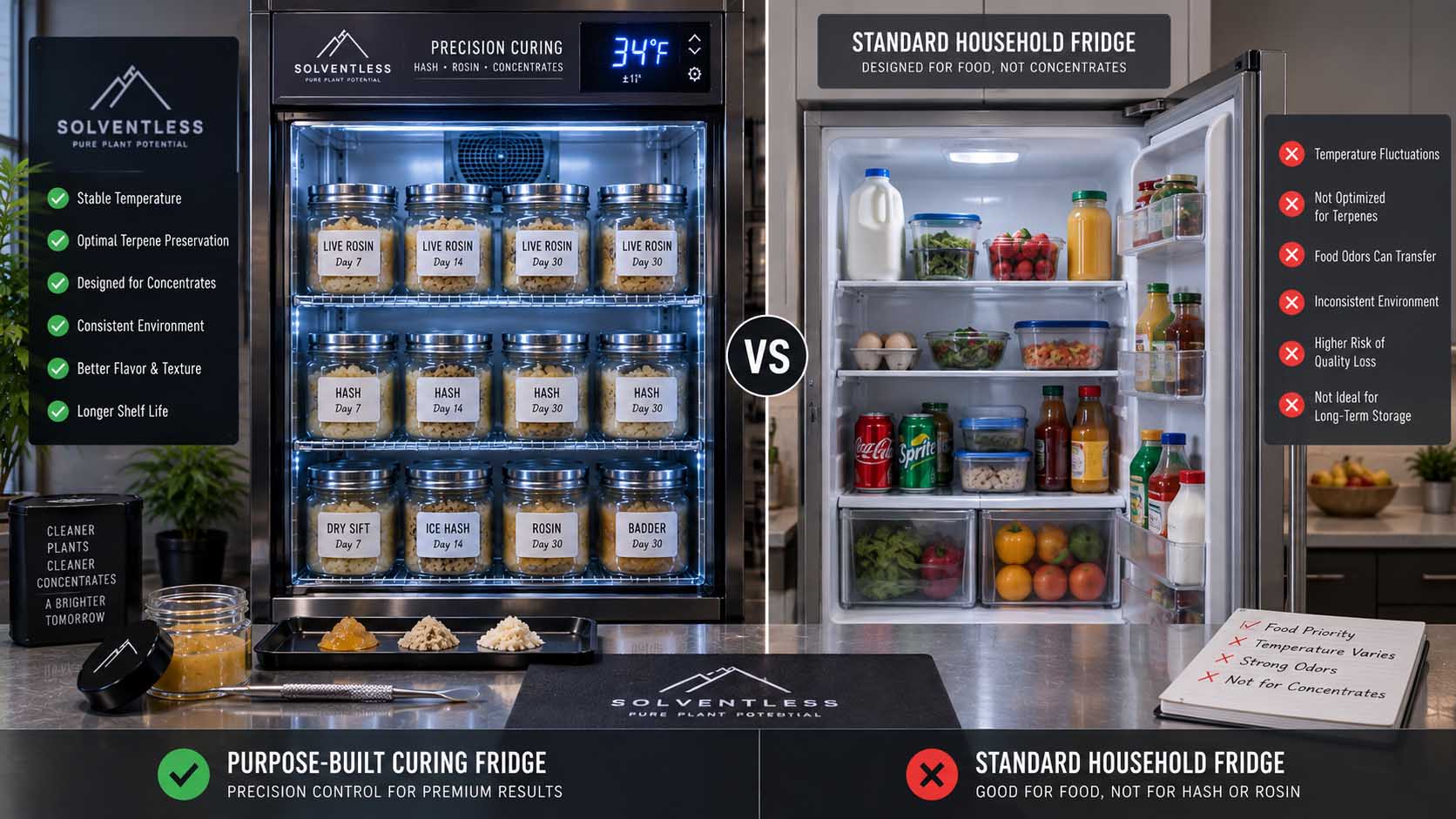
A dedicated hash curing fridge and a household refrigerator may both provide temperature-controlled environments, but they are designed for different purposes. A household refrigerator primarily preserves food and beverages, while specialized curing equipment is intended to support controlled post-processing workflows for hash, rosin, and other cannabis concentrates. The key differences involve purpose, temperature management, workflow control, organization, and how the equipment fits into curing and storage procedures.
Understanding these differences helps processors decide whether ordinary refrigeration is sufficient for their needs or whether a dedicated system makes more sense for repeatable concentrate processing.
What Is a Dedicated Hash Curing Fridge?
A dedicated hash curing fridge is equipment used specifically to manage temperature during selected stages of hash or rosin processing.
Unlike simple cold storage, curing can involve intentionally allowing resin to develop under controlled environmental conditions. Depending on the workflow, processors may use cooler conditions for cold curing or warmer controlled conditions for other curing approaches.
Therefore, the equipment’s role is broader than merely keeping concentrates cold.
Professional processors may also want to move material between curing and storage stages while maintaining an organized workflow. A dedicated unit gives them a space reserved for these materials rather than sharing refrigeration with unrelated products.
What Is a Household Refrigerator Designed to Do?
A household refrigerator has a straightforward primary purpose: keeping everyday food and beverages cold enough for normal domestic storage.
Its controls, shelving, door configuration, cooling cycles, and general operating characteristics are designed around that objective.
That does not mean a household refrigerator can never be used in a small concentrate workflow. It can provide a cooler environment, and some processors may use ordinary refrigeration for certain storage needs.
However, providing cold conditions and supporting a specialized curing workflow are not necessarily the same thing.
The appropriate choice depends on what the processor actually needs the equipment to accomplish.
Dedicated Hash Curing Fridge vs Household Refrigerator
The most important difference is process intent.
A household refrigerator is primarily a storage appliance. A dedicated curing system is selected because temperature forms part of the processing workflow.
This distinction becomes clearer when comparing several practical areas.
Temperature Management
Household refrigerators maintain conditions appropriate for food storage. Users generally choose from the temperature controls provided by the appliance and then use the interior for a wide variety of products.
Hash and rosin processors may have more specific requirements.
They may want controlled conditions for cold curing, hot curing, maturation, or subsequent concentrate storage. They may also want the ability to establish repeatable procedures across different batches.
As a result, temperature requirements should be evaluated according to the curing method rather than simply asking whether an appliance can become cold.
Dedicated Processing Space
A household refrigerator may contain drinks, food, opened containers, and frequently accessed items.
A curing fridge can instead remain dedicated to concentrate processing.
This separation makes it easier to organize batches, limit unnecessary disturbance, label containers, and establish procedures for when material enters or leaves the equipment.
For professional operators, dedicated space can become part of a standardized production system.
Why Purpose-Built Equipment Can Support Curing Workflows
When temperature is an active processing variable, operators may benefit from equipment designed around that purpose.
For example, the iCure Hash Fridge is positioned for professional hash and rosin workflows that include hot curing, cold curing, and controlled storage rather than functioning solely as a conventional domestic refrigerator.
This broader role is important because curing and storage are separate objectives.
During curing, processors intentionally use environmental conditions to support development or stabilization. During storage, the goal generally shifts toward maintaining the material after it reaches the desired condition.
Equipment capable of supporting multiple stages can make those transitions easier to integrate into one post-harvest workflow.
Why Temperature Stability Matters
Regardless of the equipment used, temperature stability is an important consideration for concentrate processing.
Repeated movement between substantially different environments adds another variable to the process. For operators trying to reproduce a successful curing method, uncontrolled fluctuations can make batch-to-batch comparisons less useful.
A more controlled workflow allows processors to record conditions alongside other variables such as curing duration, starting material, container type, and observed consistency.
This does not mean every concentrate requires the same temperature.
Instead, it means the selected conditions should match the intended method and remain sufficiently controlled for the process to be managed deliberately.
Hot Curing Changes the Equipment Question
Comparing curing equipment with a household refrigerator becomes especially relevant when a workflow extends beyond cold curing.
A domestic refrigerator is fundamentally a cooling appliance.
A professional hash-processing workflow may require controlled warmer conditions for hot curing as well as cooler conditions for cold curing and later storage.
Therefore, processors who use multiple curing approaches should evaluate whether their equipment supports the complete temperature range and workflow they actually need.
Trying to adapt an appliance built only for refrigeration to a broader processing method may require additional equipment or separate environments.
Organization Matters in Professional Processing
Equipment capacity should not be evaluated only by its physical volume.
Processors should also consider how easily individual batches can be separated and accessed.
Several containers may represent different cultivars, wash batches, pressing dates, curing stages, or intended finished products. Clear labeling and organized placement make it easier to track those differences.
A dedicated curing environment can support this organization because the entire interior serves one primary processing purpose.
By comparison, a shared household refrigerator may be opened frequently for unrelated reasons, potentially making process control and batch organization less convenient.
Containers Still Play an Important Role
Specialized equipment does not eliminate the need for appropriate containers.
The immediate environment surrounding hash or rosin depends partly on how the material is packaged. Containers should suit the concentrate, close properly, and fit the intended handling procedure.
Operators should also consider what happens when cold containers leave the controlled environment.
A very cold container moved into warmer, humid air may experience condensation on its surfaces. Opening it immediately can expose the contents to a different environment before the container has adjusted.
Therefore, good curing and storage procedures include both temperature control and careful container handling.
Is a Household Refrigerator Enough for Small-Batch Processing?
For some limited storage applications, ordinary refrigeration may be adequate. The answer depends on the processor’s goals.
Someone storing a small amount of finished concentrate has different requirements from a business managing repeated batches through cold curing, hot curing, maturation, and storage.
Before investing in dedicated equipment, processors can ask:
- Is the equipment needed only for cold storage?
- Will it be used for active curing?
- Does the workflow include both hot and cold curing?
- How many batches need to be handled?
- How important is repeatability?
- Will the appliance be dedicated to concentrates?
- How frequently will containers be accessed?
- Is controlled storage also required after curing?
These questions help define whether general refrigeration or specialized processing equipment is the more appropriate category.
Where a Curing Fridge Fits in the Solventless Workflow
A curing fridge is typically a downstream component of a larger solventless processing system.
For hash destined for rosin production, a simplified sequence may include:
Cannabis material → ice-water washing → trichome collection → drying → rosin pressing → curing → storage
Different products can follow different paths, but curing occurs after earlier processing stages have prepared the resin.
This means curing equipment should not be selected in isolation. Operators should consider how batch sizes, containers, pressing capacity, curing capacity, and final storage work together.
Equipment that fits the complete production flow is generally easier to integrate than equipment chosen without considering upstream and downstream stages.
Choosing Between Dedicated and Household Refrigeration
The choice ultimately depends on the job the equipment needs to perform.
A household refrigerator is primarily a general-purpose cooling and storage appliance. For straightforward cold storage of small quantities, that may satisfy the user’s requirements.
A dedicated hash curing fridge serves a more specialized role. It becomes relevant when processors want an environment specifically incorporated into hash and rosin curing, maturation, and controlled-storage procedures.
Professional operations may particularly value dedicated space, process organization, repeatability, and the ability to establish documented procedures for different concentrate batches.
The practical difference between a dedicated hash curing fridge and a household refrigerator is therefore not simply that one is more specialized. They are designed around different objectives. By defining whether the goal is basic cold storage, active curing, or an integrated curing-and-storage workflow, processors can select equipment that matches the actual needs of their operation.