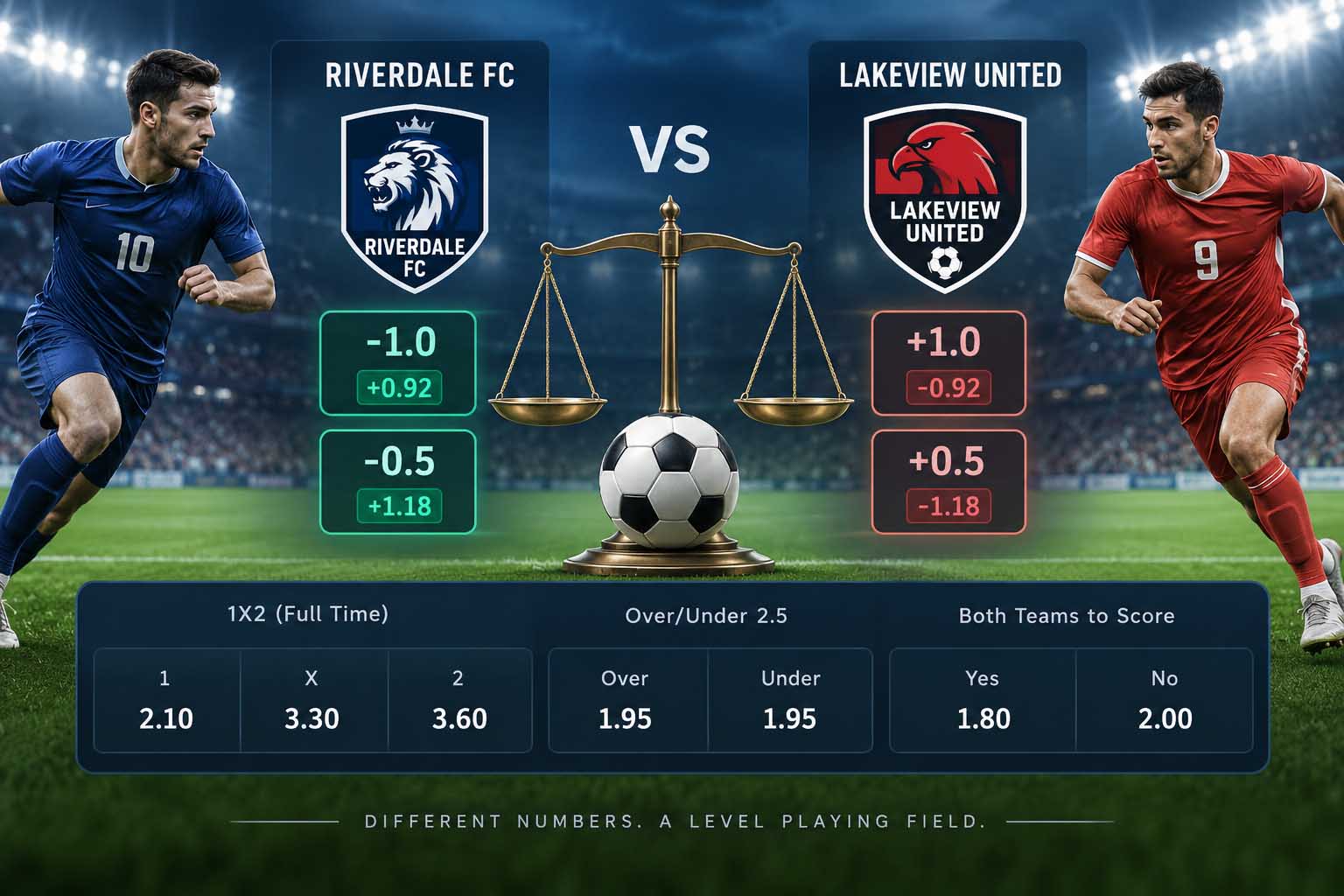
Asian handicap explained simply means understanding how a football market uses a numerical adjustment to evaluate two opposing teams. Instead of relying only on a standard home-win, draw, or away-win structure, a handicap line gives one side a virtual advantage or disadvantage for the purpose of settling that particular market.
The actual football score does not change. The handicap exists only within the market calculation. This distinction is the foundation for understanding how Asian handicap works.
What Is an Asian Handicap?
An Asian handicap is a football market built around an assigned handicap line. One team may receive a positive handicap while the opposing team receives a corresponding negative handicap.
For example, a market might display:
Team A -1.0
Team B +1.0
These numbers are not predictions of the final score. Instead, they define the adjustment used when the market is evaluated.
The negative sign generally indicates that a team starts with a virtual disadvantage for settlement purposes, while the positive sign represents a virtual advantage.
Because different handicap lines create different conditions, the exact number is as important as the teams themselves.
Why Do Sportsbooks Use Handicap Lines?
A traditional 1X2 football market contains three standard selections: home win, draw, and away win.
Handicap markets organize the possible outcomes differently by incorporating an adjustment into the settlement process.
This creates a market based not only on which team performs better on the field but also on how the actual result compares with the specified handicap.
The concept can be summarized as:
Actual match result + specified handicap = adjusted market result
This formula is only a conceptual way to understand the structure. The exact settlement still depends on the line and applicable sportsbook rules.
Asian Handicap Explained With a Simple Example
Imagine Blue FC plays Red United.
Suppose the relevant handicap market is:
Blue FC -1.0
Red United +1.0
For market-evaluation purposes, Blue FC carries a one-goal disadvantage, while Red United receives a one-goal advantage.
If Blue FC wins by a sufficiently large margin, its negative handicap can still result in a successful market outcome. If the margin is narrower, the settlement can differ.
The important point is that simply knowing which team won the real match may not be enough. The result must also be considered together with the handicap line.
This is why handicap markets should always be read as a combination of team + line, rather than looking at the team name alone.
Understanding Positive and Negative Handicap Lines
The signs attached to handicap numbers provide important information.
Negative Handicap
A negative handicap places a virtual disadvantage on the selected team.
For example:
-1.0
The team must overcome that adjustment when the market is evaluated.
Positive Handicap
A positive handicap provides a virtual advantage for settlement purposes.
For example:
+1.0
The adjustment is applied in favor of that team when determining the market outcome.
A beginner can therefore read handicap selections by asking two questions:
Which team am I looking at?
What numerical adjustment is attached to it?
Both pieces of information are necessary.
Asian Handicap vs 1X2
Asian handicap and 1X2 are both associated with football results, but they organize outcomes differently.
A standard 1X2 market uses:
1 = home win
X = draw
2 = away win
Asian handicap instead introduces numerical adjustments to the teams.
Therefore, the main distinction is:
1X2: evaluates the standard match-result categories.
Asian handicap: evaluates the result after considering the specified handicap line.
Readers reviewing a sportsbook platform may encounter handicap markets alongside 1X2 and other football options, so recognizing the market label and its numerical line is essential before interpreting the associated odds.
Why the Exact Handicap Number Matters
Not every handicap selection works identically.
A line of -1.0 creates different settlement conditions from -0.5, just as +1.0 differs from +0.5. Some Asian handicap markets may also use quarter-goal lines.
Therefore, seeing the word “handicap” alone does not provide enough information.
Readers should check:
- the team attached to the selection;
- whether the line is positive or negative;
- the exact handicap value;
- the applicable settlement rules;
- the period of the match covered by the market.
These details determine what conditions apply to the selection.
Whole, Half and Quarter Handicap Lines
Asian handicap terminology can include several types of numerical lines.
Whole-Goal Lines
Whole numbers include values such as +1.0 or -1.0.
Because the adjusted result can potentially finish level, these lines can have settlement conditions that differ from half-goal lines.
Half-Goal Lines
Half-goal values include numbers such as +0.5 or -0.5.
The half-goal element prevents the adjusted result from ending exactly level on a whole number.
Quarter-Goal Lines
Quarter values can include numbers such as +0.25, -0.25, +0.75, or -0.75.
These lines require more careful interpretation because their settlement structure can effectively divide a selection across adjacent handicap values.
Beginners should check the sportsbook’s specific rules rather than assuming that every handicap line behaves in the same way.
Does Asian Handicap Change the Actual Match Score?
No. The handicap does not alter the official football result.
If a match finishes 2–1, the real score remains 2–1 regardless of the handicap market.
The numerical adjustment is used only to determine the outcome of that particular market.
This distinction helps separate sporting facts from market mechanics:
Official score = what happened in the football match
Adjusted result = how the specified handicap market is evaluated
The two should not be confused.
How Odds Relate to Handicap Markets
Each handicap selection can have associated odds.
However, the odds should only be interpreted after the market line is understood. Two selections involving the same football team can represent very different conditions if their handicap values differ.
For example, a team listed at -0.5 is not the same market proposition as that team listed at -1.5.
Therefore, reading handicap information in the correct order is useful:
Team → Handicap line → Market conditions → Odds
Starting with the odds while ignoring the handicap number can lead to misunderstanding what the selection actually represents.
A Practical Way to Read an Asian Handicap Market
Beginners can use a simple process whenever they encounter a handicap listing.
First, identify both football teams and determine which one has the positive line and which has the negative line.
Second, read the exact numerical value. Do not ignore decimal or quarter values.
Third, consider how that adjustment would affect the result for market purposes.
Finally, review the relevant rules, especially when dealing with whole-goal or quarter-goal lines.
This method keeps the focus on the market structure rather than trying to interpret the odds in isolation.
Asian Handicap in the Wider Football Market Structure
Asian handicap is one part of a broader group of football markets.
A sportsbook may also organize fixtures around 1X2 results, goal totals, over/under lines, and other defined outcomes. Each market evaluates the match from a different perspective.
The important relationship is:
Football match → Market type → Selection conditions → Odds
For Asian handicap, the market conditions include a numerical adjustment. That adjustment is what separates it from a standard match-result selection.
Understanding this principle makes the terminology much easier to read. Asian handicap does not change what happened on the football field; it changes how a particular market evaluates that result. By identifying the team, positive or negative sign, exact handicap line, and applicable rules before considering the odds, beginners can interpret Asian handicap markets far more clearly.